
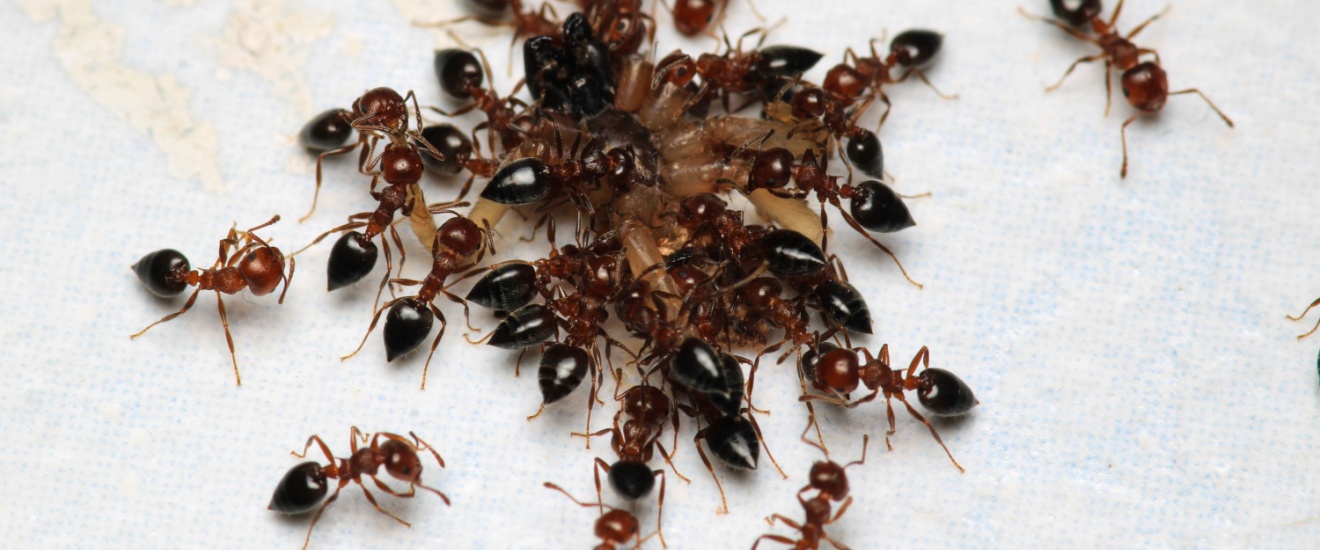
Getting rid of ants in Fresno is simple—if you want them gone temporarily. Getting rid of them permanently is where most homeowners hit a wall—because the methods that seem like they should work are not designed for the kind of ant pressure Fresno properties face. You spray the trail, the ants disappear for a day, and then they are back—sometimes in the same spot, sometimes in a completely different part of the house. The cycle repeats all summer, and by September you have spent more on consumer products than professional treatment would have cost, with nothing to show for it except frustration.
The reason ants keep coming back is that the methods most homeowners use address the visible symptom—the trail on the counter—without touching the colony that produces it. Getting rid of ants permanently in Fresno requires a different approach, and it starts with understanding what you are actually up against. Here is how professional ant control eliminates ant problems at the source—not just the surface.
The Colony Is the Problem, Not the Trail
The ants you see inside your Fresno home are foragers. They are workers sent out by a colony that may number anywhere from ten thousand to several hundred thousand individuals, depending on the species. The colony lives outside—in the soil near your foundation, under your driveway, inside landscape mulch, or (in the case of carpenter ants) inside moisture-damaged wood.
When you spray the trail with a consumer product, you kill the foragers. The colony does not notice. The queen is still producing workers. The nest is intact. New foragers are deployed within hours, and they either follow the residual pheromone trail to the same entry point or discover a new one.
This is why the trail keeps coming back. You are removing a handful of workers from a population of thousands. The colony replaces them faster than you can spray them.
Why Consumer Sprays Make Things Worse in Fresno
The ant species most common in the Fresno area—Argentine ants—make consumer repellent sprays particularly counterproductive.
Argentine ants form supercolonies: massive, interconnected networks of nests with multiple queens that cooperate rather than compete. A supercolony can span multiple properties and contain millions of individuals. When a repellent spray is applied to a trail, it kills the ants it directly contacts—but it does not reach the colony. The chemical residue left behind repels the surviving workers, who detect it and avoid the treated area entirely. They do not walk through it and die. They reroute.
Because Argentine ant colonies have multiple queens and naturally reproduce by budding—splitting off portions of the colony to establish new nesting sites—the disruption caused by repellent sprays can accelerate this fragmentation. The practical result is that homeowners who spray one trail often find ants entering from new locations shortly afterward. The colony has not been reduced. It has been dispersed—and dispersed ant activity is harder to control than a single concentrated trail.
The spray did not fail because it was applied incorrectly. It failed because repelling a multi-queen supercolony does not eliminate it. It redistributes it.
How Professional Ant Control Eliminates Colonies
Professional ant control uses a fundamentally different class of products and a fundamentally different strategy than what is available on store shelves.
Non-repellent products: These are the cornerstone of effective ant elimination. Non-repellent insecticides are undetectable to ants—they cannot smell, taste, or sense the product on treated surfaces. Foragers walk through the treated zone, pick up the product on their bodies, and carry it back to the colony. Inside the nest, the product spreads through the population via contact and food sharing (trophallaxis). Over one to three weeks, the product reaches the queen, the brood, and the workers. The colony collapses from within.
This transfer effect is what makes professional treatment fundamentally different from a contact-kill spray. Instead of removing ten ants from a colony of fifty thousand, it uses those ten ants as delivery vehicles for a product that reaches the entire population.
Targeted barrier application: A professional-grade barrier treatment applied around the foundation, entry points, and conducive areas creates a sustained treated zone that foragers must cross to reach the home. This barrier maintains effectiveness for weeks—even in Fresno’s extreme heat—unlike consumer sprays that degrade within hours.
Interior crack-and-crevice treatment: The product applied at specific entry points inside the home—under sinks, along baseboards at door frames, and around plumbing penetrations—intercepts foragers and provides additional transfer-effect exposure.
Species-specific strategy: Different ant species require different approaches. Argentine ants respond to non-repellent transfer products. Carpenter ants require locating the nest—which may be inside structural wood—and treating it directly. Pavement ants nesting under concrete need subsurface treatment. A professional identifies the species before recommending a strategy. A consumer spray treats them all the same way—and gets them all wrong.
What Homeowners Can Do to Support Treatment
Professional treatment eliminates the colony. Homeowner habits reduce the conditions that attracted it:
- Seal entry points: Caulk cracks in the foundation, around window frames, and at utility penetrations. Replace worn weatherstripping. Ensure the garage door seals flush.
- Reduce moisture near the foundation: Fix leaky hose bibs. Adjust irrigation so water does not pool against the house. Ensure gutters and downspouts drain away from the foundation.
- Pull mulch back: Maintain a 12-inch gap between mulch beds and the foundation. Keep mulch depth to two inches or less.
- Clean up food and moisture sources inside: Wipe down counters, store food in sealed containers, fix dripping faucets, and do not leave pet food and water bowls out overnight.
- Trim vegetation: Keep shrubs and tree branches from contacting the home’s exterior—they serve as ant highways to upper-level entry points.
Getting Rid of Ants for Good
Getting rid of ants for good requires two things working together: colony elimination through professional treatment and ongoing maintenance that prevents recolonization.
In Fresno’s climate, warm soil temperatures support ant activity for most of the year. The surrounding agricultural landscape continuously introduces new ant populations to residential areas. That means a one-time treatment provides temporary relief — not a permanent solution. Recurring service, typically bi-monthly, maintains the barrier and keeps colony pressure managed through every season.
Pestman Termite and Pest Control has been eliminating ant problems across the Fresno area for over 50 years. The company knows which species are present, how they behave in this specific climate, and which treatment strategies deliver lasting results rather than temporary suppression. Every service agreement includes a free callback guarantee—if ants return between visits, so does the team.
If you are tired of the spray-and-pray cycle and want ants gone permanently, contact Pestman Termite and Pest Control for a free estimate and find out what colony-level treatment looks like.