
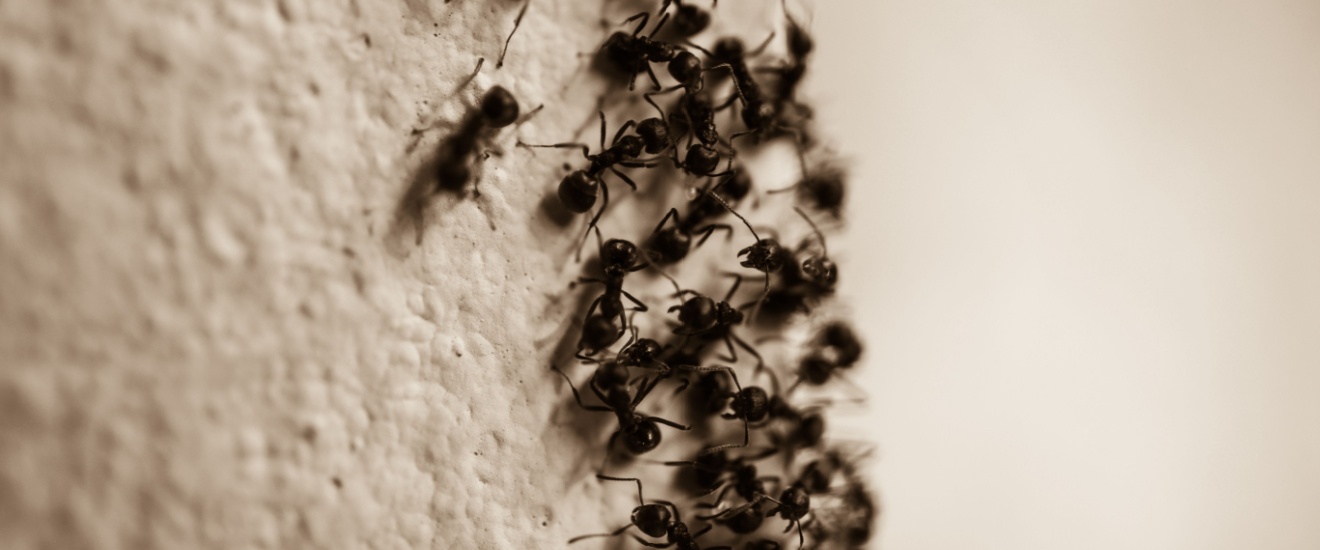
You cleaned the counter. You sealed the cereal boxes. You found the crack near the back door and caulked it shut. The ants disappeared for three days—and then showed up again, this time trailing along the bathroom baseboard toward the sink. Different room, different route, same problem. If this cycle has been repeating in your Fresno home for weeks, months, or even years, it is because cleaning, sealing, and spraying only address what you can see. The colony producing those ants is still thriving outside your home, and until it is eliminated, the trails will keep coming back. Here is what is actually driving the cycle and what it takes to break it with professional ant control.
The Colony Never Left
This is the fundamental point that explains everything. The ants you see inside your home are foragers—workers sent out by a colony living in the soil near your foundation, under your driveway, inside your landscaping mulch, or (with carpenter ants) inside moisture-damaged wood. When you spray the trail or wipe it away, you remove a few dozen workers from a population that may number in the hundreds of thousands. The colony does not notice. The queen is still producing new workers. The nest is intact. And the pheromone trail—the chemical signal that guided foragers to your kitchen—is remarkably durable. Even after you clean the surface, enough residual scent remains to guide new foragers to the same general area.
That is why the ants come back. You addressed the symptom. The source is still operating at full capacity ten feet from your foundation.
Why New Trails Appear in Different Locations
If you have noticed that ants reappear in a different room or enter from a different crack after you treat the original trail, there are two likely explanations—and neither is good news.
- The colony is exploring new routes: A healthy ant colony sends scouts in multiple directions simultaneously. If one route is blocked or treated with a repellent product, the colony does not give up on your home. It simply redirects. Other scouts have already found or are actively finding alternative entry points. Your home has dozens of potential access points—cracks in the foundation, expansion joints, gaps around utility penetrations, worn weatherstripping, and the gap under the garage door—and the colony will test them all.
- The colony has budded: If you used a repellent spray—the kind sold at most hardware stores—there is a real possibility that the colony has split. Argentine ants, the dominant species in the Fresno area, respond to repellent chemicals by budding: a portion of the colony, including one or more queens, separates and establishes a new nest in a different location. Instead of one colony with one set of foraging trails, you now have two or more colonies approaching your home from different angles. The spray did not fail to kill the ants it touched. It succeeded at making the overall problem worse.
The Fresno Factor
Ant problems in Fresno are more persistent than in many other markets because the San Joaquin Valley’s environment is almost perfectly engineered for ant colony success:
- Year-round warm soil: Fresno’s mild winters rarely produce the sustained freezing temperatures that kill ant colonies in colder climates. Colonies survive from year to year with minimal die-off. Populations accumulate rather than reset.
- Constant irrigation: Every residential property in Fresno is irrigated during the dry season. That irrigation creates a consistent moisture layer in the soil near foundations—the exact conditions that Argentine ants, odorous house ants, and pavement ants need for nesting. The colonies are right there, inches from your entry points, sustained by the water you are putting on your lawn.
- Agricultural recolonization: The orchards, fields, and agricultural operations surrounding Fresno support enormous ant populations. As land is developed, those populations integrate into residential areas. And the ongoing agricultural activity continuously introduces new colonies through soil movement, irrigation, and seasonal cycles. Even a property that has been professionally treated and cleared of ant activity can be recolonized from the surrounding landscape within weeks if the treatment barrier is not maintained.
What Actually Stops the Cycle
Breaking the pattern requires addressing the colony—not the trail—and maintaining that pressure over time.
- Non-repellent colony-elimination products: Professional treatments use products that ants cannot detect. Foragers walk through the treated zone, pick up the product, and carry it back to the colony. The product spreads through the population via contact and food sharing. Within one to three weeks, it reaches the queen. The colony collapses from within. This is the opposite of what a repellent spray does—instead of scattering the colony, it uses the colony’s own social behavior as the delivery mechanism.
- Sustained barrier treatment: A professional-grade barrier applied around the foundation and entry points maintains a treated zone that intercepts foragers attempting to enter the home. This barrier is formulated to last for weeks despite Fresno’s heat and UV exposure—unlike consumer sprays that degrade within hours.
- Recurring service: In Fresno’s climate, a single treatment provides temporary relief. The warm soil, the irrigation, and the agricultural recolonization pressure mean that new ant activity can develop within weeks of a one-time treatment. Bi-monthly service—which Pestman Termite and Pest Control recommends for most Fresno homes—maintains the barrier, refreshes treatment at entry points, and catches new colony activity before it reaches the inside of the home.
- Homeowner habits: Between professional visits, reducing the conditions that attract ants amplifies the treatment’s effectiveness: fix leaky faucets, pull mulch back from the foundation, seal entry points as you find them, clean up food residue, and adjust irrigation to avoid saturating the soil against the house.
When to Call
If ants have come back more than once despite your efforts to clean, seal, and spray, the colony is close, the entry points are numerous, and consumer methods are not going to resolve it. That is the point where professional treatment saves you time, money, and the daily frustration of finding a new trail in a new room every morning.
Pestman Termite and Pest Control has been eliminating ant problems across the Fresno area for over 50 years. The company identifies the species, targets the colony, maintains the barrier, and guarantees the results—if ants return between visits, the team comes back at no additional charge.
If ants keep coming back no matter what you try, contact Pestman Termite and Pest Control for a free estimate and find out what colony-level treatment can do that spraying never will.